Over the last few years, I’ve encountered a number of books in all genres, fiction and non-fiction, that seem quite disengaged from their presumed readership. This appears to have coincided with an uptick in online “literary communities” where writers only talk to and write for each other. There have been several conversations lately, on social media and in actual publications, about the State of Publishing, accompanied by a lot of hand-wringing about How Bad Things Are. And, certainly, things seem quite awful, with so many layoffs and cuts to staff and personnel everywhere that keeping up is nigh impossible. But there are fewer conversations about how authors are being directed to produce very particular kinds of books, in very insular circumstances, and with little regard for a readership wider than a small circle of friends. Here are some preliminary thoughts I had on the matter.1Literary communities tend to focus on fiction and poetry, but their attitudes and politics often seep into the world of nonfiction writing.
If you like this, please support my work
One of the key questions you have to address in any kind of a writing pitch is, “Who is your audience?” In some contexts, this entity is easy to imagine: if you’re writing a dissertation at a university, the answer is somewhere between five people (the average number of faculty on a committee) and twenty-five (the average number of individuals who might read the finished work without being emotionally blackmailed by you). If you’re writing a book proposal, you have to imagine who your ideal reader is: if you’re writing a guide to organising your life, this might be someone who really needs to know how to organise their time and their sex life. If you’re doing a deep dive into what happened during a major historic volcanic eruption, it will have to be someone who is deeply interested in Vesuvius and geological events.
I don’t mean to be glib, at all: thinking about your ideal reader is a reflective exercise that can be profoundly enlightening, comforting, and properly destabilising (you start to question your place in the world, in mostly a good way, when you have to imagine more than eleven people reading your work). It’s a lot like imagining your ideal spouse, if you should be into that sort of thing: Will they pay attention to your ideas? See them to the end? Will they shell out $24.95 plus tax for your book? Will they speak to their friends about you only in the best and most loving terms, or will they snark and tear you apart online?
Of late, it seems that writers no longer care about an audience beyond the friends with whom they travel, meet at bars, visit during holidays, or text endlessly about life, love, and everything. Reading these books, whether fiction or nonfiction, feels like being the new person in town at a very hip party in some obscure and little-known basement in Brooklyn while dressed in one’s favourite suburban mom jeans, and not in an ironic way. You flit from group to group, and everyone resolutely pretends to not see you while chatting about co-op schedules, their children’s ailments, and the latest essay by the latest writer in the latest literary magazine. When, you wonder, is it polite to exit? Is it too late for the train? How much will a Lyft cost? How long before you can execute an Irish Goodbye and get the hell out of there?
Andy Miller, writer, critic, and co-host of the world’s best literary podcast Backlisted has a rule about reading: finish the book. I learnt some books ago that this is an excellent rule for fiction, when I ran into what I thought was an insurmountable contradiction in a certain novel. I almost hurled the tome at the wall and screamed, to no one in particular, “This makes no sense at all!” As it turned out, no it didn’t, but that was part of the point of the character’s development: a previous incident in their life had caused extremely uncharacteristic behaviour. Finish the book. Even when it seems boring, finish the book, because the incoherences might turn out to be part of the point.
I can’t adhere to the rule with nonfiction, try as hard as I might, unless I’m set to review the book. I’ve excused myself for this on the grounds that while a novel constructs a world and I am obligated to see how that unfolds, a nonfiction book has a thesis and if I don’t agree with its central premise, or if the damn thing can’t be bothered to show its face in the first ten pages, there is no point in continuing to make myself miserable. As an example: if a book about sexuality asserts that trans people simply cannot be part of the topic because they are not cis and “natural” members of either sex, I am not going to bother with it. (Again, unless I’m reviewing it.)
If you like this, please support my work
So, with all that in mind, I read a novel that was on several “Most Anticipated Books” lists and which did seem like it would be absolutely spectacular.2I am not going to name any of the books I allude to here: the titles don’t matter as much as the issues I want to raise, and I have no interest in creating fodder for long drawn out social media trolling exercises. It was about people in whom I had a real interest, and I hoped it would be a great, breezy, fun summer read, which is how it was advertised. The blurbs were never-ending in number, just miles of them, it seemed, from every major outlet and writer.
The first two chapters were mildly interesting, even though the characters were introduced in a somewhat clumsy way. Jane Austen provides few physical details and yet you can fully see each one of the Bennett sisters and their parents in Pride and Prejudice in the first few pages. Charles Dickens goes about it differently, layering detail upon detail — recall Uriah Heep, and that you will never forget what he looks like, or his hands. In contrast, most contemporary writers have had it workshopped into them that they must provide little mini-life summaries of a character’s looks and previous experiences at the first introduction: “Her blonde hair fluttered listlessly around her face, while her blue eyes darted anxiously around the room, signs of the early childhood trauma she had endured at the hands of her mother.”3I exaggerate — or do I? This novel was in that vein, with endless bits of needless detail.
Slowly, the plot unfurled, or so I thought. For a while, things seemed to happen, until it became clear that nothing would. This, again, is not, technically, a problem. The issue here was that a moment of crisis was presented as the fulcrum of the novel, and then simply disappeared as we were fed more pointless descriptions of the central characters. There was, in the end, nothing much to hold on to, nothing that really made me interested in anything at all, just a lot of vacuous descriptions of who these people were, in ways that exposed the MFA-ness of it all, with methods that have become tediously familiar to anyone who has had the misfortune of reading too many writing-mill-produced novels.4The MFA style — detached, crafted to the point of inducing boredom, and filled with needless details — even appears in works of fiction not written by actual MFA grads but emulated by writers, because most publishing houses these days insist that fiction read like it was stamped by A Famous Writing Program. At some point, I even scurried back over the pages, worried that I might have fallen asleep, picked the book back up at the wrong spot, and simply missed some key parts. No, nothing there.
This was a novel that had been wildly extolled for months prior to the publication date as an excellent read. Looking back at the reviews, I noticed that they all failed to make any substantive points and that they all read much like each other — which meant they had been mostly cribbed from the descriptions helpfully provided by the publicity agent. I sighed. The next day I placed the book in the little free library in the park near me. It disappeared, only to reappear a few days later.
If you like this, please support my work
Another book, non-fiction, was by an author I admired a great deal and whose previous and much-cited work continues to be a lodestar for many in the field. I didn’t expect this one to be exactly like the previous book, but I hoped for that same sense of world-making zeal, a ruthless call for optimism even in these hard times. Instead, what emerged were pages and pages of didactic and heavy-handed descriptions of emotions wrapped up in sometimes obscure references, accompanied by thickets of notes. I was never drawn into a book that only seemed to be written for a small circle of friends. There were, here and there, allusions to relationships and sex in which I had no interest — if those were meant to draw me in, they failed, and I wanted more about the political issues that were supposed to be at the heart of the work. The thick passages of academic explanations were distracting and boring, and seemed designed to impress an audience of scholars and historians more than the general reader it aimed to reach towards. I’m an academic, and even I thought these segments were dull. The book felt like an afterthought to a set of conversations that had already transpired elsewhere.
I am both a writer and a reviewer, and I’m writing two works of non-fiction and a Young Adult novel — none of that is impervious to criticism or critique. I’m not a part of any literary communities, and don’t have the money to hang out at whatever literary events might be going on anywhere. But I do have a small group of friends and colleagues who are excellent readers and editors, and our implicit arrangement with each other is that, yes, we will read and comment on whatever needs a new pair of eyes — even, often, with very little notice. I have never looked for editors and readers to simply validate me with praise because that contributes nothing to the work, and I don’t bother with people who, clearly, only want to be told how great they are.5Please don’t approach me with offers to edit my work or requests that I do the same for you. One of the dangers of writing these days, when a work might never appear in print but only online, is that a writer tends to conform their style and approach to an imagined community that does not really exist except in the shape of “likes” and retweets or restackings, and begins to mistake all of that as a sign of a vibrant community of readers.
Even if that were the case, a writer should not really be writing for any “community,” unless the work is only meant to circulate within a small set of people.6Community as a word and concept is itself meaningless. For more, see nearly all my work and Miranda Joseph’s Against the Romance of Community. As many authors — including the ones whose work I just described — are discovering, that false and fictive “community” is not likely to support you by actually buying your book or subscribing with real money to your blog. It will be there to cheer you on as you recount all your health problems in detail or watch as you flame out in toxic wars with people online — but rubbernecking is not real engagement. Even Lindy West — once a massively popular and still very online writer — is discovering that excessive parasociality can’t sell books.
If you like this, please support my work
There’s a small and somewhat whiny — and mostly male — online literary “community” of people who seem to think that writing is a circle jerk.7For more on these, see my forthcoming “Where The Boys Are: LitTwit, Substack, and a Culture of Misogyny.” Here, the “discourse,” such as it is, is extremely narrow and requires a specialised knowledge of figures, scandals, and gossip that no one outside certain bubbles is likely to know or care about. This is fine, if all you want to do as a writer is be told how good you are, by other writers and your friends. Increasingly, the publishing industry — at least one significant part of it (both the books I described were from major publishers) — fails to distinguish books written for readers from books written for very particular readers. Virality (as with a blog or an article) or online popularity often drives publishing deals (I’ve written about this here) — but it can also mean that an author ends up writing towards an algorithm. Again, Lindy West is only one example but an instructive one: her publisher must have imagined that her significant online presence and number of fans would help push sales.8Of course, the only predictable factor in publishing is that nothing is predictable — West’s numbers may still go up. There is also an entire conversation to be had about prioritising sales over readership, but that is for an entirely different essay. The problem, at least as far as can be discerned, is that West was writing for her “community,” when she should have been writing for strangers.9For more on West, see my forthcoming review of her memoir.
For those of us who think of writing as a way to enter the actual world and create narratives that draw in more than just those who already know us, the most basic rule is the simplest: Write for strangers.
If you like this, please support my work
For more, see:
On Writers and Parasociality
The NYT Book Review Is Everything Book Criticism Shouldn’t Be
Is This the End of Book Reviews?
When Critics Turn to Cultural Studies, and Fail
The Publishing World Is Like Fyre Fest
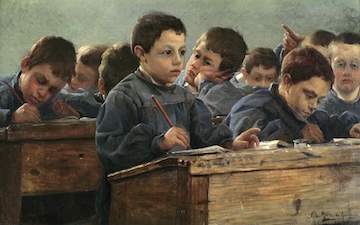
Image: Paul Louis Martin des Amoignes, In the Classroom (1886)
Don’t plagiarise any of this, in any way. I have used legal resources to punish and prevent plagiarism, and I am ruthless and persistent. I make a point of citing people and publications all the time: it’s not that hard to mention me in your work, and to refuse to do so and simply assimilate my work is plagiarism. You don’t have to agree with me to cite me properly; be an ethical grownup, and don’t make excuses for your plagiarism. Read and memorise “On Plagiarism.” There’s more forthcoming, as I point out in “The Plagiarism Papers.” If you’d like to support me, please donate and/or subscribe, or get me something from my wish list. Thank you.