Many thanks to M. for the input.
We can thank John Mulaney for parasociality. Or, rather, for causing a relatively unknown psychiatric term to suddenly burst forth into everyday public discourse. In 2021, the comic announced that he had finished a stint in rehab, was divorcing his wife, was now in a relationship with the actor Olivia Munn, and that they were having a child. The news shocked his legions of fans — Mulaney had up to that point painted a picture of an exceedingly happy marriage with Anna Marie Tendler — and thousands of women went online to berate him as if he were their husband and had betrayed them individually. Their responses were absurd, since Mulaney had and has every reason to live his life the way he chooses, but the furore brought parasociality into sharp focus, and the term is now widely and casually used in everyday conversations.
The word “parasocial,” invented by the sociologists Donald Horton and Richard Wohl in 1956, refers to a one-sided relationship where an individual feels emotionally, intellectually, and romantically invested in a well-known person, despite the absence of reciprocity. This may or may not result in stalking, but always involves “illusions of intimacy, friendship, and identification.” The object of fascination has no idea of these strong feelings. Parasociality is different from fandom which, even at its most devout, maintains a distance between the two people in question. Most actors, pop stars, and other celebrities are aware of parasocial fans and wary of their sense of extreme entitlement: a recent Instagram reel shows someone trying to intrusively take a selfie with the actor Harrison Ford as he walks on quickly, and a voice can be heard insulting him when he doesn’t stop. In 2024, the singer Chapell Roan felt compelled to write bluntly to demand that fans stop their parasocial behaviour: “Please stop touching me. Please stop being weird to my family and friends. Please stop assuming things about me.” Fans of the gay hockey show Heated Rivalry have overstepped their bounds and berated its stars Connor Storie and Hudson Williams for being too queer, not queer enough, too old, too white (Storie), and too Asian (Williams). Even more recently, the writer Lindy West, the author of a controversial memoir, has become embroiled in a stew of parasocial discourse so thick that even people who have yet to read her book are furiously online, and furiously expressing their opinions about her relationships.
West is among a relatively new brand of celebrities subjected to the fumes and winds of parasociality: writers. But she is also among an emerging breed of writers who have very deliberately stoked the flames of parasociality, creating branded lifestyles that directly encourage their readers to see them not as mere writers but best buddies, chums, pals, sister-wives.1For more on West and parasociality, see my forthcoming review of her memoir. This is fine for West and others like Miranda July whose work is less about writing and more about curating public personalities. But writers like me who would just like to write without having to serve ourselves up to the never-ending dinner theatre of the public gaze have cause to be wary and even nervous or fearful of people who overstep their bounds. As I learnt recently.
If you like this, please support my work
I write in relative isolation. There are writers who hang out at parties, salons, and bars, whereas I act like John le Carré living on a cliff in Cornwall though, alas, without the millions. I’m in touch with my regular subscribers and supporters, some of whom I have known for a very long while, and people on my social media feeds, as well as a handful of writer friends. But I’m not a writer in the public sense which, these days, means running a mini-empire of podcasts and a cultivated presence on Discord, Patreon, Substack, Bluesky, Facebook, Twitter, Instagram, and LinkedIn. (I’m moderately active on the last four.) I don’t really know where my work goes or lands, so it is always a very pleasant surprise when someone takes the time to write kind words about something of mine they read. I’ve also been the subject of plenty of online vitriol, and I am the veteran of several flame wars — so many that I’ve lost count. Most recently, I incited a massive wave of fury for daring to write a critical review of Chasten Buttigieg’s memoir. This triggered a certain swath of very online, very mainstream gays and their “allies,” all of whom melted into a (performative) tizzy.
When an email with the subject line “greetings / unique” dropped in my inbox, I was curious and clicked on it. Scanning it quickly, I saw the words “an article of yours on Chasten Buttigieg” and sighed. I knew I needed to check its contents and forward it to friends, in the event of the letter-writer showing up to kill me. I was fully expecting something on the lines of “Yasmin Nair, you are a hateful, ugly whore who hates gay men and their beautiful children and I hope you are beaten to death.” (If you think I’m exaggerating, take a look at an actual tweet about me that emerged in the Buttigieg kerfuffle.)
What I found instead is hard to describe. Over the course of two hours, I received three unwanted emails from a complete stranger whom I shall call B.2I am hiding his identity because I don’t think doxing him does anyone any good. I’m not against doxing in principle: I just think it needs a really good reason, and being an absolute ass does not count. I suspect he would have continued sending missives all night if I had not put an end to them: the deluge only stopped when I finally wrote and asked him to cease. Even then, he felt compelled to respond (more on that later). Altogether, I received approximately 1500 words of mostly incomprehensible drivel.
B. wrote that he was a very admirable male and was willing to let me be his friend. Writing in the stilted language of space aliens in movies from the 1950s, he began with, “I am a stranger to you, so I begin with introduction[sic].”3I have cut and pasted his words in exactly as they were sent to me, without any editing, and left in the original punctuation and any grammatical errors or typos. He went on, “I am practically monastic. I am homosexual. I am white, cis-gender, masculine, 5’11”. I had a privileged upbringing: my family is very stable, I never had any trauma.” I have no idea if that last point was meant to forge an intellectual kinship with me, since I am well known for my critique of trauma discourse.
After a few rambling autobiographical paragraphs that included details of his childhood, he came to the point: “Anyways, I am writing to you because I came across an article of yours on Chasten Buttigieg, his book. I am impressed by the quality of the piece and your thinking. Although you are not as radical as I am, I respect your thoughts. I would like to simply be able to treat with you [sic] and possibly be a ‘pen pal’ of sorts. To give you a flavor of my thinking, I have recently uploaded a self-published book to ResearchGate [redacted title ].” He continued, “I would be honored if you would spend time with my book. Practically, you will sharpen your analytical skills — I develop a [redacted] language that is easy to use and powerful. I believe equipping you with this mode of thought will enhance your powers. Also, I would very much be interested in hearing your thoughts on my book and suggestions for getting it published.”
The writer Joan Didion, whose fame far surpasses mine, once received a query from a fan asking, and I paraphrase, “I love your writing. Can I be your friend?” To which the startled Didion responded, and here I paraphrase again, “Oh, god, no.”4I came across this anecdote many years ago, and have not been able to find it again. If you have a source, please let me know.
I also thought of John Fowles’s novel The Collector in which John Clegg, who collects pretty things like butterflies, decides to add a human — a young and beautiful woman named Miranda — to his collection.
Was this stranger trying to adopt me as a friend or collect me as a trophy? Was I to be a specimen, pinned to some wall in a basement somewhere? Was he a visitor from space, seeking me out as a wondrous human being, my DNA to be spliced into his to create a new species? (I am not young, but I do possess the beauty of a plump, sleek seal.) Was he simply trying to find free labour to help him in his writing career? Or was this all just an example of the extreme parasociality that has overtaken culture at large?
If you like this, please support my work
Parasociality is not restricted to major celebrities: in a time when becoming an influencer is sometimes the only way to earn a living, many people feel compelled to nurture it in some form, no matter their profession. We are all influencers now, and influencers have to cultivate and nurture parasocial relationships if they are to make any money at all. Even people in professions once seen as isolationist and solitary, like writing and painting, feel obliged to talk about themselves incessantly and in public, and to offer much more than writing or art alone. In a recent Instagram post, a chef I follow listed some of her qualities and openly asked her hundreds of thousands of followers if she was “friend material” for them. Anyone who just writes and then publishes a book or articles, hoping that people will read them, is now a relic from an older era. As I’ve written in “The Writer as Magazine,” one must no longer simply write, oh, no, no, no.
But these days you’re not a writer if you’re not, in effect, a magazine. Do you just write? How boring, how very…early 1990s. Surely you render advice for a fee? Do you have a game you can teach us, any skills you can pass on? Can you stand on your head for five minutes and TikTok that, just so we can experience you on another platform? Are you on Substack? Twitter? Facebook? Discord? Can you facilitate a discussion about something, anything at all? Did you take a vacation? Oh, well, then: where are your photos on Instagram?
On a recent podcast, a writer and researcher answered the standard end-of-episode question, “Where can people find you?”with a long litany of social media platforms and emphasised that they were on all the time, and could and would answer any questions anyone might have. Hearing this, I screamed, in my empty living room, “Nooooooooo!! Whyyyyyy? Don’t do it!”
But this is what everyone — from writers to singers to home chefs — is compelled to do: you have to be “on” all the time, no matter your field. If you’re not on, you don’t exist. Adding to the pressure is the fact that so many people feel compelled to “pivot to video,” and this is why we see so many short reels on TikTok or Instagram in our timelines, bristling with mundane observations. To be fair, given the nightmarish times we live in, even I will confess to being glad to have so many voices of sanity informing us of current events and giving us the analysis we often need, quickly and as chaos erupts all around us on a daily basis.5Please don’t ask me for recommendations: I repost reels fairly regularly on Instagram and you can see them there, but I hesitate to recommend any in particular because they sometimes disappear or are wildly inconsistent in their politics. It is easier and quicker to grab a microphone and your phone and record something urgently than it is to sit down and pen something that has to be formatted and pasted on a site anywhere. Video may have killed the radio star but it may also bring about change.
Celebrities like Mulaney and Taylor Swift are in professions that require them to maintain contact with fans to some degree (the latter is famous for showing up at fans’ weddings). They cannot be aloof and cold, and have to maintain at least an aura of approachability and assume friend-shapes, as it were. (It is worth noting that the singer Enya has sold 80 million albums without ever going on tour or making appearances in the media, and that she lives very well in an actual castle with innumerable cats.)
There are enormous differences between, say, me, and Taylor Swift and John Mulaney who are actual celebrities — besides the fact that I cannot hold a tune and certainly cannot write, memorise, and deliver an excellent comedy bit. Swift is protected by an invisible phalanx of security guards, while I have to worry about some whacko showing up on my door. They each have assistants to take care of their incoming mail, while I have to plough through my messages every day using my own two hands. I am hardly above writing about my personal life, or of things that happen to me, but I make a point of only doing that if there is a larger political and cultural point to make. Over time, I’ve become cautious about social media followers: I have seen the best minds of several generations rot into petty, bloviating turnips as they spend their entire days arguing with seen and unseen enemies everywhere: conventional wisdom is that incendiary walls bring the most views, and that more views mean more followers and readers. But views and followers — and even Substack subscriptions — don’t automatically translate to book sales or readership, especially now that the media landscape is severely bloated and readers are often hopping between dozens of writers’ blogs every day. Several of the best-known cases of flame-riddled social media accounts involve people whose brains are permanently damaged from years of living constantly in the flames of spite and anger.
On Facebook, the platform designed for the most intimate exchanges, I’ve steadily reduced my number of friends from about 4800 (the maximum allowed by Facebook is 5000) to somewhere around 1500. I really don’t care whether I end up with a thousand, five hundred, or fifty, because my mental health is too important to me: managing trolls is a headache. I cull every day and no longer accept new friends. My settings are configured to prevent anyone who is not a designated friend from commenting on my timeline. (Anyone who wants to keep up with my work and posts can simply use the “follow” function.) I have no idea if I am the exception or the norm these days, and I don’t really care.
As publishing venues decline in number, even writers who should feel comfortable in their readership are producing more work filled with the most private details. They devolve into trauma-bonding with their readers, sharing events and emotions which really ought to be kept to one’s private circle and medical professionals.6Sadly, the nearly-non-existent state of healthcare in the U.S means that people are driven to desperation in seeking advice in public. The great danger in revealing so much online is that you eventually run out of selves to reveal and must begin to invent new ones. I’ve known writers to cycle through various platforms over decades — some have never not been online since they were teens — and forget which lies they told where. Eventually, falsehoods are exposed, and they must scuttle away into new handles until there are no more selves to invent.7One way to reinvent a self, popular among the most toxic online trolls, is to stage a mental breakdown or to keep hinting at such. This can help to stave off criticism for vicious takedowns or lies, but there is a limit to how often this card can be deployed (no more than one or two per lifetime.) Another tactic is to erect a wall of domesticity: nothing creates a bulwark against criticism like a baby or spouse, preferably both. The truly skilled trolls do all of this, in successive eras.
Parasociality has crept into writer profiles as well: one no longer turns to an account of an author in, say, the New Yorker, to learn anything about, say, their writing process or their career. In a strange author profile (we need a different name for this exercise), the New York Times’s Marie Solis drives around with the author Miranda July to get a Persian rug and then returns the next day to help her install it. We learn very little about July’s book All Fours. Jenessa Abrams’s review of the same book in theLos Angeles Review of Books is mostly about the reviewer’s misacarriage. I wish such parasocial profiles were aberrations, but they seem to be becoming the norm. As someone who writes for a living, it terrifies me that readers cannot connect to writers unless they are allowed to enter their homes, see every mundane detail of their lives, and, vicariously, shop for rugs with them. And yet, writers these days seem to revel in such: July’s Substack promises a wild time, as if opening the door to a secret sex club where no one knows your name: “Be a subscriber if you want the more unhinged, experimental, improvisatory MJ stuff in all mediums.” Her newsletter, she promises will be “like I’m writing you.” Abrams’s author site features a photo of her in her bathtub with an expression that says, “Come in, come in, look at how quirky I am, isn’t this silly?” The writer is no longer a writer but a spectacle, a theatrical production, a giver of experiences, an intimate partner. She will write directly to you, no place is private, wink, wink, come on in, take a seat, right there, on the toilet, while I scrub the day away. With writers like these, who can blame readers, especially of the slightly unhinged variety, who think that friendship with writers is just one click away?
If you like this, please support my work
I suspect that what drives readers to a parasocial relationship with writers is not that they want to be with the objects of their attention, but that they want to become them. Entire films and novels exist about this kind of parasociality in the arts — we could look before and after the 1950 film All About Eve, starring Bette Davis as a fading Broadway star who sees a younger actress slowly take over her career and life. The difference today is that we live in far more desperate times and with an infinitely larger number of publishing outlets for fans, writers, and readers. As the publishing industry crumbles and falls into ruins, more people are turning to Substacks to create blogs.The people behind them seem to have had long-simmering dreams of becoming writers. They give their blogs names like “Missives from the Anus of Satan” or “Just Toodling: Letters from the Happy Hearth.” Everyone is a writer, and almost no one has any idea what that really means: deadlines, very little money, constant hustling, late pay, and no healthcare unless you’re lucky enough to be married to someone with a stable job.
Anyone should be able to turn to writing for a living, or as a hobby, and we need to build a society that supports and nurtures such dreams — and publications as well. But we’re not there, and “writer” has a certain hold on the public imagination: in many people’s minds, all writers live the Carrie Bradshaw life of Sex and the City and And Just Like That, in charming New York brownstones, palatial apartments, and multi-story houses. It does not help that too many writers, like Elizabeth Gilbert, perpetuate the idea that writing is not labour but some kind of mystical activity — and can earn you millions. A writer friend is one way to move towards that, to live such a life vicariously and perhaps to entirely occupy it.
If you like this, please support my work
After the third email, I realised B. was not going to take the hint from my silence and wrote a short, terse note that I hoped would shut him up.
Thank you for reading my Chasten Buttigieg article.
However, I must ask you to please stop writing to me. I am not interested in any correspondence about your work. I hope you find others with whom to have these one-sided conversations.
Please do not respond to this.
Of course, because B. is a man and must have the last word, he felt the need to respond:
Thank you for the response. I will not respond or write any further, confirmed. I will continue to read your work with interest. I am not interested in one sided conversations. This is the only reason I reply. Thank you for your time.
I was not afraid of B., as unsettling as I found his emails, and I took the precaution of forwarding his emails to friends as I received them. But I was not amused or flattered. The emails began on December 26, during a period that I had explicitly designated as a break for myself, so it mostly irritated me that I had to deal with a windbag’s bloviating into my inbox (and had to bother my friends about it). The gendered nature of B.’s correspondence is obvious, even to the most obtuse man: I have spared readers all the contents of the emails, but they were filled with strange ideas about the roles of men and women, and he positioned me as someone who would read his work and provide feedback, typical of the many sexists I’ve encountered all my life for whom women are just walking vaginas and serve in secretarial functions, if at all. The incident also caused me to reflect upon my relationships with readers and social media, and to re-examine what I want my life as a writer to look like — not just in terms of who might be reading my work, but how I write towards them.8I expand upon this further in “Write for Strangers.”
Most of all, I was angry because the encounter, such as it was, revealed so much about how writers these days are positioned within a writing economy: we can no longer simply write. We are not humans but merely portals to a vision of a different life. While the emails were not explicitly violent, they were intrusive and arrogant and assumed too much: they stripped away my sense of privacy and integrity.
I have hesitated to write this essay, fearing that the kind of readers whose letters and responses I welcome, even when they are in disagreement with me, might cease to write, fearing that they are being intrusive. “I am a stranger to you,” wrote B., and this is ordinarily how I go about introducing myself in the world, if not in those exact words. I count among my Best Beloveds humans (and their animals) whom I have never met (and we shall meet some day). I’ve maintained epistolary friendships with several people over the years, “pebbling” memes and notes with them. I have asked some for help, out of the blue, and others have done the same with me. I may not frequent bars, and I am not the sort who eagerly opens conversations with strangers on trains (I often pretend to be asleep at the first sign of friendliness.) Friendship is a capacious thing, and I have always been open to testing its boundaries and limits.
But words like “friend” and “writer” ought to mean something.
Being a writer means that I will always concern myself with issues that matter deeply to people who read my work, and nothing delights me more than knowing that it has resonated with them. It is one thing to receive kind and thoughtful words of appreciation, or even words of rigorous disagreement that are not framed in the “Jane, you ignorant slut” manner that so many men adopt. But it is an unfortunate fact that writers like Miranda July have built their brands around being completely accessible to their readers: both she and Lena Dunham are immensely successful writers not because of the quality of their work but because they spend most of their days convincing readers that reading them is a piffling part of the experience: they are friends, first and foremost and nothing, not even their literal private parts, will be hidden. Become my friend, they promise, and maybe we’ll meet Brad Pitt! Maybe be a part of my “whimsical, whirlwind London wedding!”
I know I am among the vast majority of writers, in different stages of their careers, who just want to write and to have their writing be compensated well enough that they might do it full-time, with healthcare and weekends off. (In other words, all of us have to move to Norway or Ireland.) Writers are also readers, and most readers have no desire to literally or metaphorically hop over the fences of their favourite writers and ring their doorbells: reading remains a private experience for most people. They may attend book events to meet their writers, certainly, but they are there for a signature and perhaps a quick word, not a lifetime of friendship and holidays in Paris and front row seats at the Met Gala.
Please, can I just write?
If you like this, please support my work

For more on my work on writing and other matters, see also:
The Unpaid Labour of Reader Engagement
Suey Park and the Afterlife of Twitter
Elizabeth Gilbert and the Pinterest Fantasy Life
We Are Strangers Here: Notes Towards An Anti-Memoir
A World of Shame: Time, Belonging, and Social Media
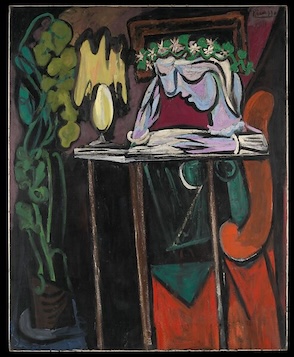
Image: Pablo Picasso, Reading at a Table, 1934.
Don’t plagiarise any of this, in any way. I have used legal resources to punish and prevent plagiarism, and I am ruthless and persistent. I make a point of citing people and publications all the time: it’s not that hard to mention me in your work, and to refuse to do so and simply assimilate my work is plagiarism. You don’t have to agree with me to cite me properly; be an ethical grownup, and don’t make excuses for your plagiarism. Read and memorise “On Plagiarism.” There’s more forthcoming, as I point out in “The Plagiarism Papers.” If you’d like to support me, please donate and/or subscribe, or get me something from my wish list. Thank you.