If you like this, please support my work.
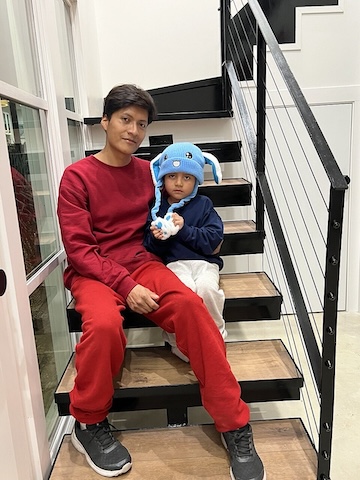
The photographs were poignant and quickly went viral: a tiny and seemingly stoic child in a vivid blue bunny hat, its giant floppy ears hanging over his own. Across his tiny shoulders hung a spiderman backpack, almost as large as him. The images of five-year-old Liam Conejo Ramos became instantly symbolic of the stark cruelty of the current deportation surges that cities like Minneapolis (Ramos’s home), Chicago, Portland, and Lewiston are facing. The family—Liam, his father Adrian, his mother Erika, and a sibling—had escaped from Ecuador in 2024 and applied for asylum in the United States.
Ramos and his father were abducted from their home on January 20, and remained in prison (euphemistically termed a “detention facility”) in Texas before finally being released on February 1.
It is highly unusual for people in such circumstances to be released so quickly—in and around that same week, several other children, varying in ages from five to seventeen, were taken with their parents and sent to various prisons; the abductions continue to this day. Amidst the swirl of events, there is little information to be found about the others, and there can be no doubt that the images of Liam Ramos were a major reason why he and his father found their freedom. Adding to the poignancy were images of himinside prison, viscerally sick from the physical and psychological strain of his ordeal. Liam’s extreme fragility as a small child garnered sympathy and protestors: his child-ness, as it were, was a key factor in his release.1Added February 5: DHS is now seeking to deport the entire family.
In an entirely different context, the Epstein files have incited anger and disgust worldwide. The names of various powerbrokers and prominent figures are tumbling into view as more are opened to the public, even if sporadically. Scanning millions of documents, reporters and online activists are revealing facts and photographs with a speed and ferocity that makes it difficult to keep track of all the names and scandals. But there the Epstein story has this in common with the one about Liam Ramos: both are about children.
Many of Epstein’s victims were some reportedly as young as eleven. Others were high schoolers, not quite eighteen and therefore legally children, still others were in their late teens and twenties and all or nearly all were effectively coerced into sexual acts with much older, predatory, and very powerful men who could silence anyone who spoke out against them. According to one report, a fifteen-year-old tried to escape Little St. James, the island Epstein bought in 1998, by swimming away, but she was caught and had her passport confiscated.
In November 2025, the public personality and former journalist Megyn Kelly created an uproar when she tried to justify the abuse by claiming, as NPR reported, that “He was into the barely legal type, like, he liked 15-year-old girls[…] I’m not trying to make an excuse for this, I’m just giving you facts—that he wasn’t into, like, 8-year-olds. But he liked the very young teen types that could pass for even younger than they were, but would look legal to a passer-by.” That last sentence makes very little sense—if they could pass for “even younger,” they would seem ten or eleven, so what would it mean for them to “look legal”? The incoherence is unsurprising: there is no rationale for what Epstein did and any attempt to create one can only result in the nonsense spouted by Kelly.
As NPR pointed out, the age of consent in the United States ranges from sixteen to eighteen, so there is literally no state in the country where any adult can legally engage in sexual activity with a fifteen-year-old.
In recent months, a significant group of now grown, adult women, aided by lawyers and elected representatives like Ro Khanna and Marc Veasey, have come forward to seek justice for what was done to them by Epstein and the wide circle of clients he amassed as an international procurer of bodies for sex. Until her death in 2025, Virginia Giuffre had been outspoken about the ways in which Epstein and his partner in crime Ghislaine Maxwell recruited a constantly replenished supply of girls and young women to satisfy him and his various associates and friends. Much of the cultural discourse around these now grown people insists that they must always be referred to as children at the time. In the Independent, Sophie Heawood takes particular issue with the phrase “underage girls,” often used to describe the victims:
Underage is such a strange word – if we’re talking about girls, they are already young, otherwise we’d call them women. Underage suggests that if they had been older, it would have been alright to traffic them and sexually abuse them. Underage suggests the only problem is if they just weren’t old enough to be treated like pieces of meat in a butcher’s shop. “Underage girls” is a sexual and legal tautology – but we are not talking about sex here. We are talking about trafficked children. We are talking about child rape.
Heawood has a valid point, that “underage” serves as an almost giggly cover for what was going on, and she is right to point out we need to stop making it easier to disguise what was going on, that we ought to confront the gruesome reality that children were effectively “treated like pieces of meat in a butcher’s shop.”
But if we were to turn even what Heawood persuasively argues for on its head, we might ask: why does it matter who among these bodies—which is how they were seen, as sentient pieces of meat—were children or not? What if there were, effectively, no children at all?
Let us imagine an entirely unlikely scenario: that Epstein and Maxwell ran an actual, legitimately recognised brothel, and that they were strict about making sure every single person working for them was neither coerced nor below the age of twenty-one. Say, in other words, that there were no children and that everyone willingly entered into sexual contracts with these two. Or, say, that there was coercion and abuse, but everyone was still twenty-one or older? Would we feel the same level of shock and sadness?
If you like this, please support my work.
The Epstein survivors are not all the same in their experiences or their ages, but if they are to gain even a shred of justice, they have to present themselves as a group of very similar as forever-children even as they also appear, very clearly, as a group of extremely intelligent, articulate, passionate, coherent and extraordinarily brave adult women. But each one of them is also fated to remain a child-victim if she is to ever gain and keep a scintilla of sympathy. I don’t state that lightly, but from long years of experience working with and talking to women and men who have had to navigate the court of public opinion while they explore legal remedies. There is a reason why a victim’s attorneys will coach her on how to dress and wear her hair in court, and even tell her how to speak. Justice is never as impartial as we like to think, and when it comes to sexual assault, women in particular have to present themselves as child-like, eternal victims of trauma. And trauma, as I’ve written very, very often, is an identity that victims have to adopt if they are to be taken seriously.
Liam Ramos is five now, and he is a conventionally beautiful young child whose truly traumatic ordeal has been recorded for posterity. In the public eye, he will always be little Liam in that blue hat and with an expression of deep sadness and confusion. We have to get everyone out of those prisons, no matter what age they are—and no matter what they might have done. If it takes turning a child into a sad meme to save his life, so be it: I think of this as the Age of Throwing Everything at the Wall To Get Things Done. We do what we can in every instance to save people. Ramos’s abduction resulted in massive protests, and in more attention to the presence of thousands of children in such “centres”—but no one, adults or criminals, however they are defined, should be in any of these.
The great danger in allowing the figure of the child to dominate our calls to end this swelling system of mass incarceration is that we will implicitly and explicitly require everyone inside to be blameless, even child-like, in their innocence. What happens to those who are not five or ten? What happens to the eighteen-year-old immigrant who explicitly refuses to support American imperialism? What happens to the thirty-seven-year-old who kills someone?
What happens if any one or more of the Epstein survivors tells a more complicated story of her abuse? A part of this vile saga that has been untouched so far is that all the systems around the children and young women failed to support them. Many have recounted being uncomfortable with what they were asked to do on their first encounters with the pair, like naked massages that ended in Epstein masturbating on them, but returned anyway. Some of them may well have sought refuge from abusive or absent families, moving towards what seemed like a welcoming home, guided by a lady with a posh accent (Maxwell) and a man (Epstein) who seemed wealthy, powerful and beyond reproach. Some may well have agreed to do what they ended up doing in order to support indigent families or just themselves, feeling alone in the world. We will never know the differing circumstances that brought them to the pair, but we do know that they all suffered abuse. While it’s necessary to demand justice from individuals like Maxwell and the many wealthy men who abused them, focusing only on the people involved allows us to ignore a society that creates systemic conditions for such exploitation. Supporters of the Epstein accusers need and actually require them to be cathected to their child-selves of long ago, to maintain their purity as unimpeachable subjects. Meanwhile, what remains are the economic and cultural issues that compel a fifteen-year-old to move with two strangers to a remote island from which she desperately tries to escape by swimming away. We can keep insisting that all the women were children at the time and we can keep calling for vengeance, but what are we doing in the meantime to make no more Epsteins exploit anyone, of any age?
How long does a person have to remain a child, and when does a child become a person?
If you like this, please support my work.
For more, see:
We Created R. Kelly
For all my work on trauma, see this list.
Image: Wikipedia


Don’t plagiarise any of this, in any way. I have used legal resources to punish and prevent plagiarism, and I am ruthless and persistent. I make a point of citing people and publications all the time: it’s not that hard to mention me in your work, and to refuse to do so and simply assimilate my work is plagiarism. You don’t have to agree with me to cite me properly; be an ethical grownup, and don’t make excuses for your plagiarism. Read and memorise “On Plagiarism.” There’s more forthcoming, as I point out in “The Plagiarism Papers.” If you’d like to support me, please donate and/or subscribe, or get me something from my wish list. Thank you.