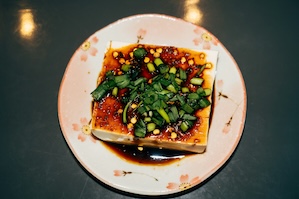
One of my very favourite dishes is also the simplest, excellent for summer, and requires no cooking at all.
Please forgive the fact that the above sentence reads exactly like something you might see in the caption to an extremely annoying TikTok or Instagram reel. The fault, Dear Reader, is not in me: the culinary world has recycled and recirculated the language of food and cooking to such an extent that coming up with an original way to describe even a beloved dish is nigh impossible these days.
But, I persevere: I can’t recall when, exactly, I “discovered” my tofu dish and I suspect it may be a variation of something I’d eaten in a restaurant or perhaps seen in a food magazine (like a 1950s housewife, I still subscribe to one, although an unforgivable error in one of its print recipes left me crushed and saddened for days). The recipe, such as it is, consists of cutting up a block of silken tofu into chunks and drizzling it with a little bit of chili oil (my favourite kind is the one that has both sesame seeds and peanuts in it). You can, if you like and if you have them handy, sprinkle chopped spring onions and, really, anything else you want over it and eat it on its own or with rice or soba noodles. It takes no time at all and if you’re a fan of tofu, it’s one of the best things on the planet (again, please forgive my perhaps cheesy enthusiasm, also horribly prevalent everywhere in the foodieverse).
I wasn’t surprised when I saw “my” dish recreated recently, on the page of a moderately popular Instagram account (MPIA). Checking on the web, I found a number of variations, unsurprisingly. In a world where more people are turning to plant-based alternatives, are not necessarily that confident in their cooking abilities, and sweltering in unforeseen temperatures, it’s only natural that this should take off as it seems to have. And yet, looking at the pictures, starting with the one on IG, I’m also horrified at how much a perfectly simple idea has been stretched and distorted beyond recognition. On MPIA’s page, for instance, the concoction looks utterly hideous: a plateau of tofu with so much chili oil that the stuff gloops down the sides and has pooled below, all of it “decorated” with a large mass of spring onions and fried shallots. You can barely see the tofu. The same is true of all the versions I found on the web, including in the photo used here: google “Silken tofu with chili oil” to see what I mean. In “my” version, the point is to centre the bean curd and not suffocate it to the point of extinction.
One could argue that food photography on social media requires this kind of surplus of colour and decorating mayhem to entice a viewer scrolling through quickly, but that only proves that we’ve descended into a world where everyone is an influencer, and plates seem designed more for viewing than eating.
It is a dismal reality of today’s economy that people have to resort to Influencer-dom in the hopes of making even a moderate income, so I can’t blame MPIA for their culinary travesty. But the flooding of a block of tofu with so much that simply washes away its essence, the tofu-ness that makes it so unique, is symptomatic of a larger trend towards saturation of colour and taste. Not only must the tofu be made to look like anything but its original self (what, we might ask, is the soul of a material wrested from the heart of a million soybeans?), but its taste must prove that whoever eats it is a brave and hearty soul whose palate extends far beyond plain tofu and a bit of chili oil.
Entire empires have risen and fallen on the spice trade, but it’s only quite recently in human history that “spicy” food has become a denominator of something approaching the elegance once granted to French cuisine. As I’ve written in “The Masalafication of Everything,” this has some advantages. Only some years ago, herbs like cilantro and spices like asafoetida were hard to come by unless you trekked to the nearest large city or found that one rather dingy store in your small town that sold more “ethnic” goods than could be found in the aisles of the local grocery chain. Today, food has gone beyond fusion, with chefs and restaurants willing to incorporate a range of elements from cuisines once separated and while I’m happy to see all of these changes, as an aspirational and experimental home cook, I often cringe at the oversaturation I see in recipes. Sure, people like me can just modify dishes however they want, but I cannot but help wonder about the subtle and not so subtle shifts in tastes.
Consider, for instance, a trend in viral reels and TikToks: the obsession with seasonings. Some of the most popular takedowns of food creators deride them for not using more than salt and pepper. Stitched reels, where people include bits from food influencers, will emphasise the parts where people cook dishes and appear to not include seasonings. The racial division here is almost always predictable: the cooks are white and usually women, while the mockery comes mostly from people of colour, including South Asians and African Americans. To be clear, it’s all very lighthearted and everyone is in on the joke which often comes up in TikToks not connected to cooking. In one, for instance, a white schoolteacher talks about what it’s like to be a minority in his predominantly Black school and how one of his students, looking at his lunch of seemingly bland chicken, said “Your food looks like the death of hopes and dreams.”
But what do we mean by “seasonings”? And are we obligated to dress everything in some combination of spices to make it clear that we’ve actually “seasoned” it properly? In one Instagram series, some commenters berated a cook for her “bland” and “unseasoned” food while others pointed out that the addition of bay leaves and aromatics meant that the food was in fact perfectly well seasoned. Of late, in the argot of the day, “seasoned” food has come to mean the use of spices like chili powder or oil, garlic, and other elements that look more like seasoning than, say, salt, pepper, and thyme or bay leaves.
The intense focus on seasonings has also meant we forget that there are few things more perfect than really good silken tofu in its plainest form or an excellent piece of chicken poached in nothing but water. For years, I was hesitant to try the latter — mostly because of too many memories of the slightly bulbous rubber chicken common on certain long-distance flights of yore. And then, one evening, I went ahead and got the best pieces of chicken I could find and tried the technique at home: the result was delicious. It’s not unlike Hunan boiled chicken, and the only real secret lies in the quality of the chicken.
And this, after all, is also what a surplus of seasonings can hide: indifferent meat or vegetables. A really good, fresh avocado doesn’t even require salt and has a naturally occurring, slightly garlicky taste that, paired with the unctuousness of the vegetable makes it perfect for spreading onto a piece of toast. Top it off with a really good egg, and you have a perfect snack or breakfast that might open you up to mockery from boomers but will leave you feeling satisfied.
All of this is more expensive now, certainly, but we might want to remember that a main reason why some restaurants drown their ingredients in sauces is that what’s underneath is not of great quality. The average supermarket chicken is a fatty, tasteless thing and only frying or massive amounts of spices can make it palatable. If you’re a home cook, it can make sense to use what a colleague once referred to as “geriatric” carrots and potatoes in dishes like stews that just cook the hell out of them, but there is a world of difference between a soup or a curry made from actually fresh vegetables and one made from the kind that were almost ready to be thrown away — and you can taste it.
The increasing emphasis on seasonings and “finishing” and a dozen other “techniques” popularised by food influencers, including people who either are or pose as “home chefs to the wealthy,” has also meant that dishes are impossible to replicate at home (and a number of them are deceptively edited to make the food look more appealing and easier to make than reality might allow). Everything is cooked in butter or cream, which is what most restaurants do to get that silky mouthfeel to you. If you cooked like the average TikTok chef, who pretends that you can eat like them every day, you’ll probably be dead within a week. And lose a few fingers trying to chop with the same (carefully edited) speed.
While I don’t go out as much as I used to, I do see and taste the differences in restaurants these days, including an overuse of salt. At some point, I hope, food influencers will be a thing of the past although that seems doubtful in a rapidly deteriorating economy where more people are losing their jobs and every field, from publishing to art to music, requires everyone to post videos and talk to people all the livelong day.
Like millions of other scrollers, I collect more reels on my phone than I’ll ever actually use. Ultimately, of course, home cooks can adjust everything to their taste. I, for one, will stick to making my silken tofu the way I like it.
Photo by Markus Winkler on Unsplash

See also:
“The Masalafication of Everything“
“Cheap Restaurants Are the Canaries in the Coal Mine”
“Hyde Park: Where Food Goes to Die”
“On Philz Coffee in Hyde Park”
Don’t plagiarise any of this, in any way. I have used legal resources to punish and prevent plagiarism, and I am ruthless and persistent. I make a point of citing people and publications all the time: it’s not that hard to mention me in your work, and to refuse to do so and simply assimilate my work is plagiarism. You don’t have to agree with me to cite me properly; be an ethical grownup, and don’t make excuses for your plagiarism. Read and memorise “On Plagiarism.” There’s more forthcoming, as I point out in “The Plagiarism Papers.” If you’d like to support me, please donate and/or subscribe, or get me something from my wish list. Thank you.