The Rachel Dolezal story, which I previously wrote about here, in “Rachel Dolezal and the Materiality of Race,” continues, in its bizarre way, with more questions and speculation.
One thread in the more recent set of commentaries has to do with Dolezal’s possible mental health. Specifically, there are now speculations about what could have driven her to embark upon such a complicated road of subterfuge and deceit. There are revelations that she may have even gone so far as to fake hate mail.
All of this has prompted commentators to muse on what, exactly, Dolezal might be suffering from. Think Progress tells us that scientists point towards a range of possibilities, including self-decption and even Body Dysmorhphic Disorder. To put it mildly, Dolezal is being given a range of excuses that would never be made for a black person who did the same thing.
What I’m going to state next needs several prefatory comments, in order to make my politics clear.
As a prison abolitionist, I’m not interested in pinning Dolezal into some spot in the prison industrial complex, even if that comes with what passes as therapy and psychoanalysis within those walls. But I also think that if “we,” a collective social we that seems so concerned about a white woman who set about pretending to be black for so long are going to be this gentle and forgiving of her, we might want to first ensure that our efforts in that realm also extend to black women, men, and children, who are continually assumed to be guilty even as they do little more than engage in the ordinary acts of public life — like walking into stores or out getting out of cars.
I’m not interested in spending years figuring out how Dolezal was guilty or not, given that the very nature of her “crime” is something we’re trying to sort out, and because that’s really not my interest in this matter. And as I’ve pointed out earlier, here and here, I don’t think we should be thinking in terms of good and bad victims of crime, either.
All that being said, we have to acknowledge that there is, in the cultural imagination and discourse around this case, a strong sense of boundaries being transgressed, even if we’re not exactly clear what those are or why the supposed transgression matters.
The Dolezal story arrives in the midst of a cultural discourse that is at this moment in time completely inadequate in terms of understanding that identity categories are both constructed and fraught with material realities.
In the case of Dolezal, we’re presented with two options: she is either a racist or a deeply troubled white woman who needs help.
There might appear to be shades between the two as we continue to discuss this case, but most of us are grappling with how to formulate a response that can do more than draw upon the two discursive inevitabilities (that she is either a racist or a deeply troubled woman). We’re still working within a very narrow set of frameworks: social construction versus essentialism, whiteness versus blackness, guilt versus innocence, and so on.
What we do know for certain is that black and white bodies are treated differently when it comes to the matter of guilt, and this is especially evident in the rush on the part of some to explain away Dolezal’s issues in psychological terms. A black man presumed guilty is instantly choked to death in public, while a white man who goes on a shooting rampage is diagnosed with psychological problems.
To put it plainly: White guilt is psychoanalysed. Black guilt is demonised.
My thanks to Richard Hoffman Reinhardt for helping me develop some of these thoughts.
Don’t plagiarise any of this, in any way. I have used legal resources to punish and prevent plagiarism, and I am ruthless and persistent. I make a point of citing people and publications all the time: it’s not that hard to mention me in your work, and to refuse to do so and simply assimilate my work is plagiarism. You don’t have to agree with me to cite me properly; be an ethical grownup, and don’t make excuses for your plagiarism. Read and memorise “On Plagiarism.” There’s more forthcoming, as I point out in “The Plagiarism Papers.” If you’d like to support me, please donate and/or subscribe, or get me something from my wish list. Thank you.

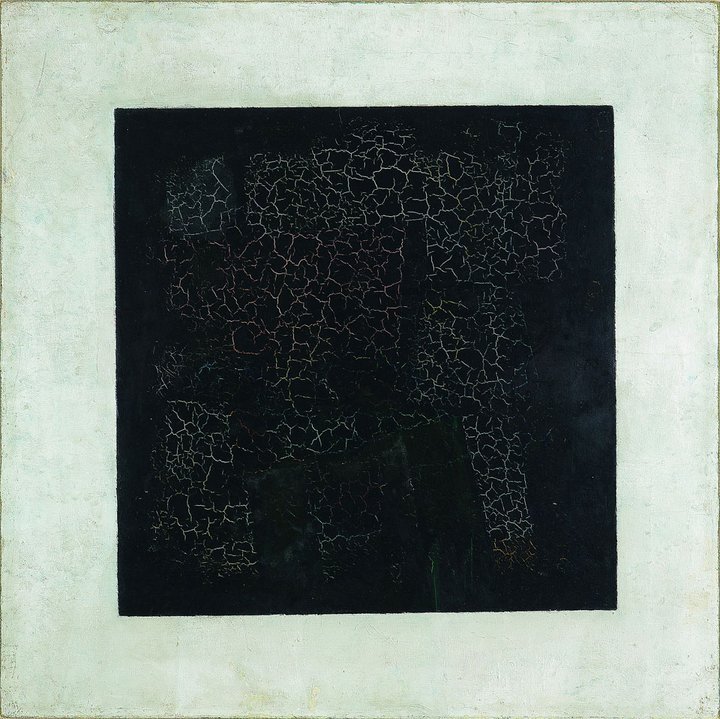
Image: Kazimir Malevich (1879-1935) Black Square on a White Ground, (1915)