
If you like this, please support my work.
I grew up in and around the Eighties, when you couldn’t really escape fire-and-brimstone preachers like Pat Robertson on all the airwaves. There they were, with their very own radio stations and television channels, in an era when we couldn’t just disengage and flit off to another browser. We actually read magazines, and these men appear on the cover of Time, which had massive numbers of subscribers—all of whom had to wait for their issues in their mailboxes.
After a while, the evangelists just became part of our political chatter and landscape, especially if you were like me and more interested in exploring left discourse and ideology. They acquired a sameness over time, with political views that became more rabid over the years. At some point, their influence waned: by 2012, gay marriage was no longer a contentious topic, for instance (and, today, many Trump appointees are gay).
The American Right never disappeared, of course, and a newer, younger, and somehow more terrifying group of ultra conservatives took the place of old, white men pontificating on television screens. Charlie Kirk, who was shot and killed just yesterday, was among a new generation of extreme right wing influencers who exerted tremendous power in politics.
I doubt that I am alone in not having paid that attention to Kirk. If someone had asked me, “Do you know what he’s about?”, I would probably have responded with, “I’m guessing he’s anti-trans, anti-Black, and thinks women should be permanently barefoot and pregnant.” There’s a certain predictability to that part of the Right, and I suspect many, many others like me, on any part of the broad spectrum of the Left, felt the same way: We knew what he stood for, without having to pay a lot of attention to him.
The assasination of Kirk makes his politics more visible to a vast number of people who might otherwise have not given him much thought. Now, news outlets everywhere are publishing “Who Was Charlie Kirk?” pieces, and social media platforms are glutted with video clips and reels of him espousing his views. Suddenly, his opinions on a range of topics are widely available, pushed from the periphery of influencer videos to the literal front pages of national and local media outlets.
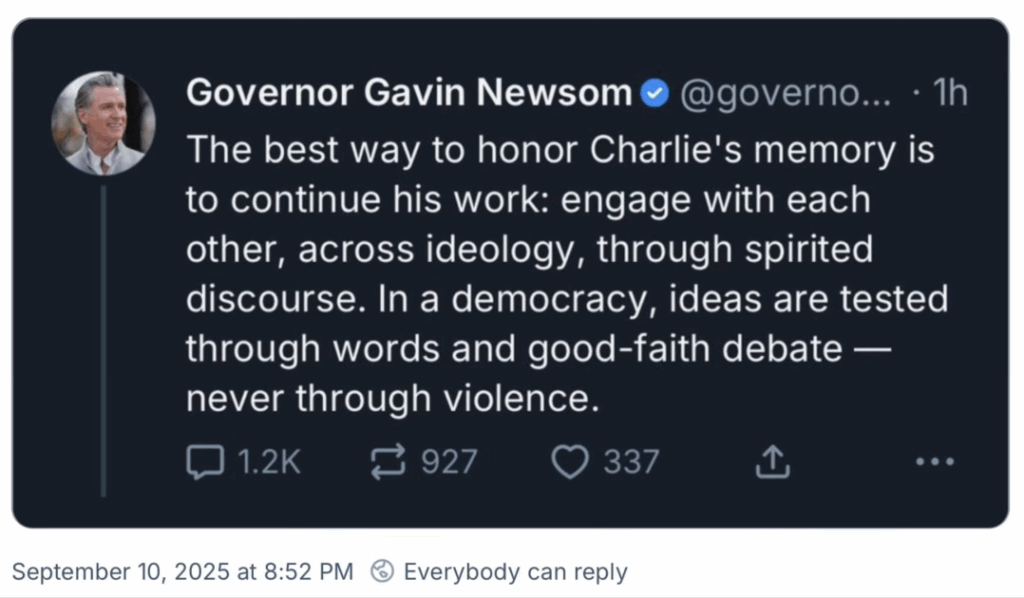
At the time of this writing, there is little known about how and why Kirk was killed and by whom. But there is now, in the public eye, a great deal more information about who Charlie Kirk was. The Right is trying to establish him as a martyr and frame this horrible event on its own terms. Many liberals are decrying the killing, emphasising that he was above all a family man and a human. Gavin Newsom, never one to let go of any opportunity to appear as presidential as possible, issued a statement on Twitter:
In response, many have responded like @alice.in.winterland:
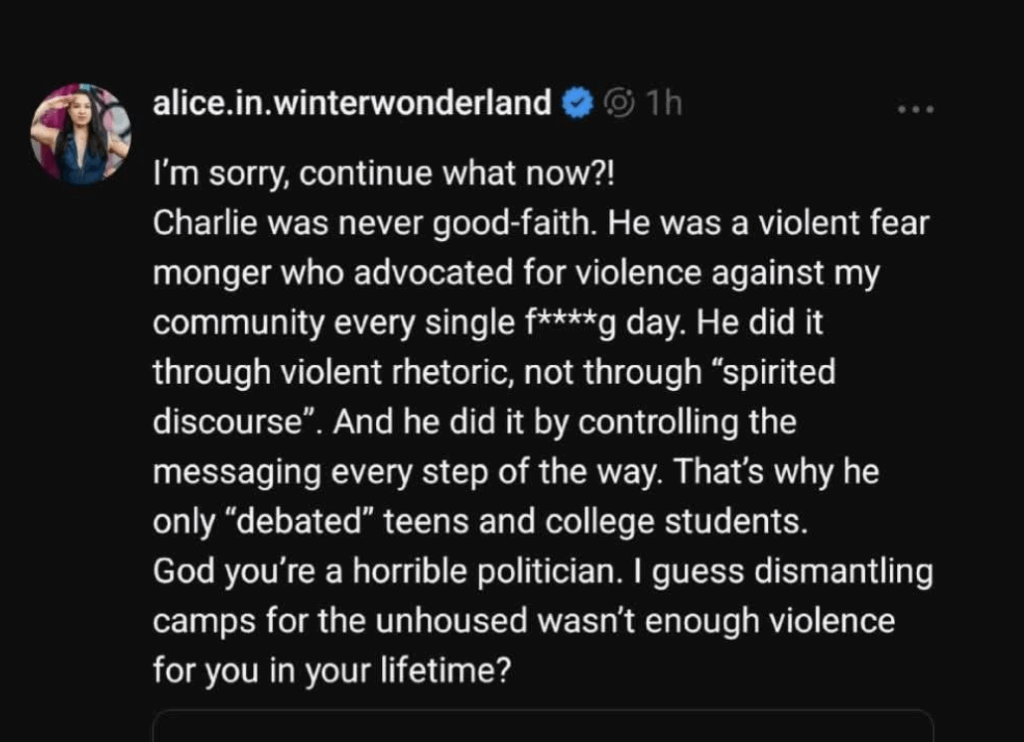
Alice.in.wonderland’s response to Newsom is bitingly clear and accurate. But it’s worth considering what it would mean to “engage” with Kirk’s ideology, if we were to follow the governor’s suggestion.
I, for one, had always understood Kirk to be a rabid conservative: my colleague Nathan J. Robinson has written about him frequently, as in this essay on how he and other conservatives misuse statistics on police killings, but even I have been shocked by the extent of his transphobia and bigotry. I suspect that many others like me are also only now seeing Kirk’s politics in the full light of day: a deep and abiding hatred of anyone who deviated from the conservative vision of cis, white, male, hetero people as inheritors of the earth.
Newsom, bizarrely, wants us to “honor the memory” of someone who appears to have spent his life dishonoring and demeaning everyone who did not look like him. This killing, while certainly brutal and sad for his family and loved ones and an unnerving political event, has the effect of actually revealing the full extent of Kirk’s politics—and that may not be what the Right or liberals like Newsom (who readily turns Right when convenient) want in the long run. More people, for whom the influencer had been just another one of a group of media figures too close to power, will now understand who Charlie Kirk really was, and they will be prompted to look more closely at his legacy. That is not necessarily a positive development for those who seek to make a martyr out of him.
Image: Gage Skidmore
If you like this, please support my work.

Don’t plagiarise any of this, in any way. I have used legal resources to punish and prevent plagiarism, and I am ruthless and persistent. I make a point of citing people and publications all the time: it’s not that hard to mention me in your work, and to refuse to do so and simply assimilate my work is plagiarism. You don’t have to agree with me to cite me properly; be an ethical grownup, and don’t make excuses for your plagiarism. Read and memorise “On Plagiarism.” There’s more forthcoming, as I point out in “The Plagiarism Papers.” If you’d like to support me, please donate and/or subscribe, or get me something from my wish list. Thank you.