My first encounter with a Tesla was on a bright spring day this March, when I ordered a Lyft. I can recall my conflicted emotions as I read the app’s description (Tesla Cybertruck): I felt like a traitor to everything I hold dear (life itself) and also somewhat curious. As it rolled up, I was surprised at how much it did in fact live up to all the mockery: as per the memes, it looked exactly like a large dumpster. (Raccoons have repeatedly tried to open Cybertrucks in their hunt for old bananas and rotting lettuce.)
My first step was, of course, to get inside, and here I found myself flummoxed. There were no discernible handles. I stood on the street, worried about cars bearing down on me, trying out various tactics like feebly waving my hand at where I assumed handles would be, at objects that looked like they were painted to resemble them. Perhaps, I thought, they worked like those equally frustrating no-touch faucets that require hand contortions at exactly the right angle? Finally, the driver, who had been staring fixedly at me, as a visitor to the zoo might look upon a slightly dim chimpanzee, did something, the doors opened, and I plunged inside.
Here, a disappointment. I expected something a lot grander, a bit like the interior of the ship in 2001: A Space Odyssey but, instead, found myself inside a gloomy, dark grey box. I sat expectantly, hoping for something of the vaunted experience that Elon Musk loved to talk about or, really, any experience at all but I only felt a pall of vague sadness and ennui. The Tesla appears to have been designed by barely grown men who had been neglected by their parents, left alone to watch every Batman movie a hundred times. Their very souls had permeated the interior and I couldn’t wait to get out. Having made a chump of myself trying to get in—and having endured a scornful look from the driver—I felt like a nineteenth-century naif visiting the big city from her small town, clutching her frayed leather case in her hand and, later, scribbling an anxious letter to her parents back home:
Dear Mother and Father,
I trust this finds you well. Today I was conveyed through the smoky streets of Chicago in a strange and monstrous machine that seemed wrought of metal into an angular shape, verily like a coffin bearing me towards my destination. It is a miracle to me that I am now safe in my room at the Belvedere Lodgings for Young Women.
Leaving the car was an ordeal because, once again, I could not find the invisible handles. At this point, I received not just a look but a scornful exhale from the driver whose face said plainly, “How stupid are you?” I plunged outwards, feeling like I had escaped a prison cell.
I’m not good with cars. I dread the day I might witness an accident or be part of one and have to answer the question, “What make of car was it?” “Black?” will be my querulous answer, because, to me, the car-ness of a car is its only identifying trait. If pressed, I might recall a ram or a horse (a mustang, yes), and “big” might be another qualifier. How big? “Huge, like a truck, but looked like a car.”
Which brings me to the size of the damn things these days. I took another Lyft today, getting it just in time as the rain began. This time, it was a Chevy Tahoe. I looked at it as it rolled up, and walked over. From a short distance, it looked normal, which only says a lot about how our ideas of “normal” have expanded.
Until I tried to get in.
I am 5 feet 5 inches tall, which makes me a woman of average height. An average vehicle should be designed to accommodate me, at the very least. This tank-like behemoth, so large it could be seen from ten miles away, did at least have handles, but I struggled to enter. The doors were heavy, perhaps designed to keep kidnappers or Bond villains from entering easily. There was a sidestep, ostensibly to help with entrance, but lacking a nineteenth-century footman to help hoist or just push me in, crinoline and all, I flailed like a hapless Corgi, butt sticking out and wiggling while I lay stretched halfway on the floor with my legs paddling in the air. (None of this is an exaggeration, and I will also acknowledge that I am not a very fit person.) I deeply regretted having left my mountain climbing gear at the foot of Mount Everest on my last trip: this was an expedition that required ice picks and rope. Only Jason Momoa, who is 6 feet 5, could have entered the vehicle with a modicum of grace. Finally, I was inside and seated, but then struggled mightily to get the door shut: clearly, my biceps are just useless noodles. The driver’s voice floated to me: “Don’t worry, just take your time.” “I will,” I responded, making sure I didn’t sound irritated. As I panted in exhaustion, we set off, and I looked backwards to see what the rest of this monster was like. Behind me, like a mini-stadium, was a cavernous space the size of a delightfully spacious studio in New York. I never did see my driver’s face as she was dwarfed by her giant seat back, which led me to believe that she was probably as petite as she seemed in her driver photo. SUVs have taken the place of the family sedan and station wagon, and this one seemed designed to haul a small pack of children across the Adirondacks to their ballet and soccer lessons. Getting out was as perilous as getting in, but I finally made it home.
At some point, cars began to be designed to be safe—largely due to the efforts of Ralph Nader to whom every passenger owes their life, whether or not they have been in an accident (although given the people in power now, even seat belts might soon be outlawed as frivolous accessories). Then, at some other point, cars took on all the anxieties of masculinity and suburban domesticity, and became ambulatory fortresses that are never as safe as their drivers imagine them to be. I once had to drive an SUV while my car was in the garage, back when they were just becoming popular, and for a few days, I understood the smugness and sense of superiority that cloaked their owners with a sense of invulnerability and the assurance that their vehicles were keeping their families safe. In fact, SUVs are more dangerous overall: they may keep the driver nominally safer, but “are 8 times more likely to kill children in an accident than passenger cars, and multiple times more lethal to adult pedestrians and cyclists.” SUV drivers tend to be more careless and uncaring drivers because they genuinely believe that they can be seen by everyone and, therefore, should have the right of way. I once sat in an SUV behind the driver’s seat and realised there was a distinct and large blind spot to my left which could be dangerous to a dismounting passenger, but the driver didn’t think this was a problem.
Combine the size inflation of vehicles and the increase in meaningless design quirks in brands like Tesla (not a car company, but a vibe marker) with the suburbanisation of the United States, and you have a world where the body of the average person—their actual needs and desires—are subservient to the image of cars. Allison Lirish Dean has long pointed out the connection between neoliberalism and car culture, and the effects on what passes for urban planning these days. “While people need cars, plenty of us would live closer together, drive less, and opt for fewer private and more shared spaces if we could,” she writes in “In Sprawl We Trust.” This is why we needn’t be against cars in general, but work towards creating a culture that’s not entirely dependent on them. In Chicago, where I live, the transportation system is racially skewed in such a way that it can take over an hour to get from the predominantly African American South Side to the mostly white North side. As a result, even people who can’t really afford them end up having to buy cars to get them to work on time without being forced to wake up at unreasonable hours. We don’t need to ban trucks either: I have several artist friends who couldn’t transport their easels or more complicated art installations without them. We just don’t want drivers crowding the streets with bigger and bigger versions of what used to be a plain and effective mode of transportation for, say, sheep, chicken, and cumbersome art installations.
We definitely don’t need these strange combinations of tanks and rolling safe rooms, like the Tesla and the Tahoe. In a country riven by economic inequality, they have become symbols of excess wealth, proof that their owners have achieved the sort of elite existence the rest of us rubes, who literally struggle to enter their horseless carriages, can presumably only dream of. But who is winning?
This is, after all, an economy where the owners of cars that cost more than $100,000 have to clock hours as Lyft drivers to make ends meet.
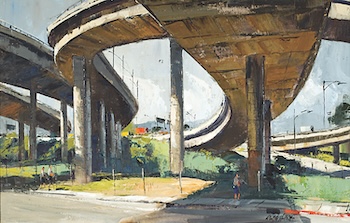
Image: Ralph Hulett (1915–1974), Under the Overpass, 1958

Don’t plagiarise any of this, in any way. I have used legal resources to punish and prevent plagiarism, and I am ruthless and persistent. I make a point of citing people and publications all the time: it’s not that hard to mention me in your work, and to refuse to do so and simply assimilate my work is plagiarism. You don’t have to agree with me to cite me properly; be an ethical grownup, and don’t make excuses for your plagiarism. Read and memorise “On Plagiarism.” There’s more forthcoming, as I point out in “The Plagiarism Papers.” If you’d like to support me, please donate and/or subscribe, or get me something from my wish list. Thank you.