If you like this, please support my work.
Note: By “writing,” I’m referring to the work of professionals, including freelancers.
There’s an exploding trend among media publications, print and online, of a push towards more “reader engagement” or “dialogue.” Writers are no longer simply required to write: oh, no, that’s very early 21st century, so passé. They must now be prepared to talk directly to readers, like physicians on call. As more publications struggle to keep readers, more of them enter Substack where they have to compete with everything from personal newsletters to political hot take columns and, occasionally, actual reporting and well-written analyses. As people’s incomes drop drastically in a time of funding and job cuts, magazines have to find ways to keep their readers.
“Reader engagement” is, broadly speaking, a way for writers to converse with readers. The idea is that this will create a “community” of people who, delighted to be able to “dialogue” directly with the writer of a piece, will support the publication or newsletter. Major outlets like the New York Times now force their writers to engage publicly by recording summaries of what they wrote and posting short videos: entering the website of that unjustifiably storied newspaper now feels like walking into a carnival and being beset by barkers. As my friend J.C points out, reporters, who surely have jobs to do without having to worry about hair, makeup, and lighting, now have to act like podcasters on top of their regular jobs. On Substack, a giant melange of blogs that call themselves newsletters with provocative names like “From the Ass of Satan” to attract your attention, engagement takes the form of writers actually addressing readers directly in comments sections (this is also true of many articles on the Times website). Several otherwise fine publications have adopted this particular style of operating — if I don’t name them, it’s because they are too many in number and because I don’t blame them for trying to hold on to dwindling sets of readers any way they can.
These days, most outlets run on the labour of freelancers — sometimes, as at the Times, they may have fancy titles like “Contributing Editor” or “Critic at Large”: these simply mean that they’re not salaried and don’t have healthcare through their workplace. Any additional labour, like podcasts and videos, is unpaid and exploitative, and that is true even for salaried writers who have enough on their plate without having to be distracted by readers. On Substack, where independent writers are desperately trying to drum up subscriptions, the situation is even more wearying, with the constant demands of readers to engage, engage, engage.
What does “engagement” really mean? I’ve noticed that some commenters seem to think of comments sections as Algonquin Tables, spaces brimming with intellectual exchanges that might someday be immortalised in a handy little book, perhaps. But the real Algonquin Table was a group of overprivileged, nasty individuals who had too much money and time on their hands and spent their days delivering snarky asides to take down their rivals and friends. Comments sections, more often than not, descend into spite and trollery, and require the writer to watch for and settle inflammatory threads seething with racism, misogyny, and transphobia. It’s not enough to be a writer anymore: you have to have a degree in Conflict Resolution and practically be a social worker.
If you like this, please support my work.
And yet, readers seem to increasingly see “engagement” with a writer as their birthright. I am on the second iteration of my website, and I have never had comments sections because I had enough experience in the early years of blogging for the now-gone Bilerico to know that I never again wanted to communicate directly with readers. I’m a writer, and a freelancer at that. Once I’m done with a piece, I have to move on to the next one — this would be true even as a staff writer at any publication, but for me there is the added pressure of getting the next gig. The last thing I have time or, really, any desire for is getting into endless conversations or arguments with readers. I once had an irate reader complain to me, over email, that my choice to not have a comments section was a strike against democracy itself.
Reader engagement does not improve the quality of writing — if anything, it can lead to an increase in bad writing practices as writers become perennially anxious and write in anticipation of yet another foreseen set of criticisms or queries. The explosion — some might incorrectly call it a flowering — of online writing opportunities has meant that more people think of writing as a hobby that’s easy and fun to do, and as a public activity.
We don’t have to resurrect the myth of the writer as a solitary genius to insist that writing is in fact first and fundamentally a private activity. A news report, an op-ed, a book review, a poem, a news analysis — whatever form writing takes, it has to follow a course that is unseen by the reader. What shows up on the page, online or in print, is only the visual evidence of what might be months of research and interviews, tracking down several sources, or hundreds of drafts that result in five lines of exquisitely written poetry.
Writing is work, and it is also movement. When a publication compels its writers to “engage” with readers, it is forcing them to stay static, to keep reliving the process that should have ended as they think about and work on their next essays. Given the intense amount of hatred and spite present in many comments sections, forcing writers to stay “in conversation” with hostile readers is pure exploitation and is bound to have profound effects on their mental health.
Can reader engagement and dialogue be useful? Sure, perhaps, in limited circumstances. But it is one thing when an independent blogger (or Substacker, if we must call them that) chooses all that on their blog (Substack), and quite another when a publication compels its writers to take on the exhausting work of continuing to discuss, endlessly, work that they are done with. It’s time for publications to end this exploitative practice and for readers to back away from the demand that a writer should be a combination of friend and therapist. Writing is not a dinner party: it’s an occupation, and should be treated as such.
If you like this, please support my work.
See also: The NYT, Meghan Markle, and the State of Media
For more on my work on writing, see this.
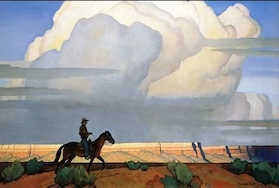
Image: Maynard Dixon, “Desert Journey,” 1935.

Don’t plagiarise any of this, in any way. I have used legal resources to punish and prevent plagiarism, and I am ruthless and persistent. I make a point of citing people and publications all the time: it’s not that hard to mention me in your work, and to refuse to do so and simply assimilate my work is plagiarism. You don’t have to agree with me to cite me properly; be an ethical grownup, and don’t make excuses for your plagiarism. Read and memorise “On Plagiarism.” There’s more forthcoming, as I point out in “The Plagiarism Papers.” If you’d like to support me, please donate and/or subscribe, or get me something from my wish list. Thank you.