I keep straining my ears to hear a sound
Maybe someone is digging underground
Or have they given up and all gone home to bed
Thinking those who once existed must be dead
— “New York Mining Disaster 1941,” the Bee Gees
Is there a more iconic figure representing the working class than the coal miner?
Coal mining has been central to industrialisation for centuries. And, worldwide, the grimy faces and hard lives of coal miners have borne testimony to the literal and metaphorical extraction of labour required to keep capitalism going. Mining is hard and dangerous work, and generations of (mostly) men have descended into the bowels of the earth, knowing that any given day could mean death.
The Bee Gees’ 1967 hit “New York Mining Disaster 1941” is among the best-known pop songs about mining; despite its title, it is actually about the October 1966 Aberfan disaster in Wales. (The band thought New York seemed more “glamorous.”) “Mining Disaster” is a poignant and beautiful song that renders tragedy into a dirge of the times (as all poetry and art has a right to do), and it contributes to our collective sense of the contradictions of mining: a profession that literally plunges people into danger, promising them a livelihood and support for the families they might leave behind.
In recent years, as climate change looms more often on the minds of voters everywhere (and among younger demographics in particular), taking a pro-mining stance has become a necessity for any conservative politician. Both Donald Trump in the U.S and Nigel Farage in the United Kingdom have pledged to bring back mining jobs and to reinvest in coal, despite proven environmental problems (some might argue, because of them). But what does that actually mean? Who benefits from all this chest-thumping on coal?
The environmental problems with coal production are long established, along with the horrible health hazards to actual miners. In the U.S, coal miners with Black Lung Disease—a Dickensian affliction—have seen the end of a program, the Coal Workers’ Health Surveillance Program, that had “singlehandedly reduced Black Lung Disease from affecting nearly 40% of longtime coal workers to as low as 2%, around 2000,” according to an NPR report. All 25 people working in the CWHSP have been let go. According to epidemiologist Scott Laney, “lung disease for miners has become a major concern again…because coal increasingly comes from mines embedded in sandstone, and which generates dust that’s 20 times more damaging to lungs than coal. That means miners are getting sicker, younger…”
In Wales, Farage’s promises to reopen the country’s mines are being met with laughter and contempt. As Josiah Mortimer points out in The Byline Times, “While Wales once had 620 mines employing 232,000 people; the last deep mine closed in 2008.” Byline’s readers have been properly scornful, with one of them writing, “I live in a former coal mining area. He’s living in cloud cuckoo land. Who does he think will go down the mines?” Most Welsh voters, among whom Farage clearly hoped to score populist points, have generational memories of how dangerous mining was and younger people would prefer safer occupations, so his grandiose plans have been met with derision everywhere. Even on a recent episode of the London Times podcast “How to Win an Election” (not exactly a working class gathering), commentators mocked and derided Farage’s coal mining dreams. The guest, journalist Will Hayward, emphasised that the Welsh have long and lingering memories of the horrors of mining. It is still not uncommon to see a certain generation of miners with what look like blue veins: coal dust quickly settles into even the slightest cuts and the scars remain that colour forever.
And yet, as of the time of this writing, Farage still insists that he will save a profession that no one in Wales cares for: this is like attending a convention of anti-nuclear activists to announce plans for a shiny new plant. He and Trump are both engaging in right-wing attempts to try and court “the common man.” In the case of Wales, the “common man” would like Farage to butt the hell out. In the case of the U.S, miners in places like West Virginia lean conservative: many voted for Trump, believing that he would help them. They don’t deserve the betrayal, and they have been failed on all sides by a government that sees them as disposable.
Farage and Trump are typical of wealthy men who have a tenuous grasp on life outside their immediate circles. In a recent interaction with California Representative Josh Harder, over the slashing of Medicaid, RFK Jr. said that many “gold star” addiction rehabilitation programs would only cost $20,000-$40,000 a month, a “fraction” of the $280,000 (in today’s money) that he had paid for his own private treatment. Harder pointed out that the average annual salary of the people he, the politician, represented was $40,000. The back and forth was hilarious—reminescent of that moment on Arrested Development when a matriarch wondered aloud if a banana cost, what, ten dollars? It was also painful to watch, a reminder that the U.S is now effectively run by elites who are so out of touch that they might as well be living on one of Elon Musk’s fantasy planets.
There is a lazy tendency amongst commentators to draw parallels between the U.K and the U.S, with the result of planing down significant differences and histories. But one stark similarity is that the right in each place is not equipped to deal with the hard realities of people’s lives. This does not mean that it will be stopped in its tracks. In Wales, perhaps, Farage will be sent packing. But the U.S is filled with an abundance of the kind of hope that John Steinbeck described as the reason socialism would never take root here: “the poor see themselves not as an exploited proletariat but as temporarily embarrassed millionaires.” In West Virginia, the miners who voted for Trump because they believed him when he said he would create more jobs in their profession needed to trust him because they and their families in the area have few other options. Unlike their Welsh counterparts, who have a public healthcare system, these men have nothing else to fall back on. And yet, at least some interviewed think he might still reverse the decision to withdraw what keeps them alive.
This past week, the Chicago Tribune reported that the village of Winnetka voted to extend its contract with “an energy provider supplied largely by a downstate coal plant.” The plant in question is “Prairie State, listed as one of the top 10 biggest polluters in the country, and [which] released over 12 million tons of carbon emissions in 2023…” The decision is not final, but it still surprised many: the village council is partly responding to Trump having cancelled funding for renewable energy and his pledge to “reinvigorate the coal industry.”
Its historical reliance on coal showed Wales what it did not want as its future while, here in the U.S, some are hoping that the past can be “reinvigorated” in some dystopian vision where miners once again descend into the pits every morning and return home to 1950s-style families with wives and 2.5 children. Reality is bound to intrude, and, at some point, even manipulative politicians will no longer be able to use a dangerous, unhealthy, and literally toxic profession to launch political screeds against environmentalism as the world crashes around us. Until then, miners will be the canaries in the coal mine of capitalism.
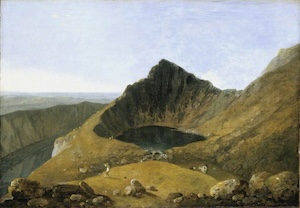
Image: Llyn-y-Cau, Cader Idris, c. 1774, by Richard Wilson (1713/1714–1782)
For more on miners, see “Necessary Evil: Did Justified Lose Its Way?,” about a television show set in W. Virginia’s coal country.

Don’t plagiarise any of this, in any way. I have used legal resources to punish and prevent plagiarism, and I am ruthless and persistent. I make a point of citing people and publications all the time: it’s not that hard to mention me in your work, and to refuse to do so and simply assimilate my work is plagiarism. You don’t have to agree with me to cite me properly; be an ethical grownup, and don’t make excuses for your plagiarism. Read and memorise “On Plagiarism.” There’s more forthcoming, as I point out in “The Plagiarism Papers.” If you’d like to support me, please donate and/or subscribe, or get me something from my wish list. Thank you.