If you like this, please support my work.
Here are links to my latest work, Daily Posts from the archives (July 7-11) in case you missed them, and articles, old and new, from around the internet. My aim is not to give you up to the minute news, but a historical understanding of our current times—too many people see everything going on as uniquely special to the current moment. You can follow me on Twitter, Instagram, LinkedIn, and Facebook (I am not accepting new friends on the last platform, but you can use the “follow” option).
If you like this, please support my work.
Hello, hello!
I hope you had a good break. I’m not sure I did: I’ve been left feeling walloped by the usual things, but we march on. I learnt a new term: “micro-naps.” Apparently, chinstrap penguins (so named because they look like they’re wearing tiny helmets with straps under their chins) take as many as 10,000 micronaps (about four seconds at a time) a day and are “the grumpiest of their kind,” according to a factoid memed by an account on Instagram and supported by Science magazine. Who would not be grumpy if one’s body forced you to wake up every few seconds?
In these hard times, micro-naps may be our best defense. I learnt how to nap from my cats, and now penguins have taught me a word to describe what I’ve taken to doing, a lot, these days.
I do not have new work this week. I neglected to remember that the purpose of a break is to not work, panicked about not having worked on anything new this past week and then realised, oh, right, that was the point of a break. I will have new work next week. But I’m delighted to present a short piece by a friend and fellow traveller, W, about the “context and newness of ICE.” They posted this on Facebook and I thought it had some original insights that others should read.
A lot has happened in the world, as you know, and it feels like something awful and momentous, in the worst possible way, now happens every two hours, at least. It is exhausting, and I think we are all very, very tired. The whole Zohran Mamdani thing happened, and then happened again, and again, in micro-waves of fake crises and false rumours, and too many Democrats are now doing their very, very best to stop him from every becoming Mayor of New York while simultaneously wondering how to attract new voters to the party. Not the smartest lot.
The Mamdani matter is interesting to me for a number of reasons. There’s the fact that it’s a startling and unexpected moment in American politics and the primary alone has had something of an effect on both national and international politics. That may be too far-fetched a surmise, perhaps, but it’s fair to say that Zohran Mamdani’s candidacy is exposing both the fissures and the possibilities of contemporary politics. We are doomed to these interesting times.
Anyway, onwards.
FROM THE ARCHIVES!
“Lyrical Doughnuts, or the ‘I’ in Writing”
“Kamala Harris and the Art of Losing”
“Surviving the Future: Abolitionist Queer Strategies” (Video, of a book discussion panel at Firestorm books)
“AOC and the Weaponisation of Trauma”
I ask you, again, “Why Are We Obsessed with Private Prisons?”
ELSEWHERE ON THE WEB!
My friend and fellow traveller W. wrote this about ICE on social media, and I’m reproducing it here with permission. I’m happy to put you in touch if you’re interested in contacting them about expanding it into a longer work. Please cite it properly if you use any part of it in your own work.
W. on ICE:
“It’s important to keep in mind the context and newness of ICE. Created in 2003 as a response to the 9/11 attacks, ICE is, generationally speaking, gen z. The idea that we ‘need’ ICE, that it ‘couldn’t’ be abolished, would be confusing to anyone living in America in 2001. More importantly, it’s the product of a new imperial excess of America, the very sort of racist global war machine that in large part elected Trump the first time around.
Given that, it’s deeply disturbing that ICE is now the largest law enforcement agency in the country. Of the 170 billion sent its way, “Almost $34bn will go to immigration and border enforcement agencies — two-thirds of all federal law enforcement spending, according to [David] Bier’s analysis. The FBI, by comparison, will get $4.2bn.”
In a lot of ways, this is a purely fabricated new 9/11: a complete reorganization of the federal government around a perceived external threat of color. There was no attack this time, and there are no real reasons otherwise for the reorganization: depending on how well the Mexican economy is doing in particular, there have been times when boarder crossings were trickling towards zero. Rationally, of course, that’s where the real focus should be: increasing pay and job protections for everyone everywhere. At least in the U.S., that was the Trump promise, which was yet another bait and switch.
I’m reminded of The Wire, one of the greatest shows ever made in American TV. There is a plot thread where the main character, Jimmy McNulty, is often turning to his friend in the FBI to ask for surveillance gear and support in order to catch drug dealers. Fitzhugh, the friend, tells McNulty that the FBI doesn’t care about drugs, unless he can relate the investigation to terrorism (which they figure out how to do, of course). My guess is that this is what’s going to happen going forward: all sorts of crimes are now going to become border crimes because that’s where the money and the capacity is: if there is a theft, a rape, a bank robbery, a drug offense, a tax offense, a ‘terrorism’ case—any of these will go a lot better if you can prove that the defendant is not ‘American’. Civil rights cases, on the other hand, will be mostly ignored unless a white heterosexual citizen has suffered.*
I suspect a number of white people will get caught up in this new, incredibly large net of terror, but the real goal is to get America to that ‘great’ time when it was mostly white and people of color knew their place.
*Edited note: the point here isn’t that The Wire serves as a creative warning: the show was merely describing what was already happening with the concept of ‘terrorism’, a term that is more political in nature than it is analytical. So cartels, organized crime and, especially under trump, BLM conveniently became terrorists to suit the government’s purposes. We saw similar expansions under anti-gang legislation where one merely needed to stand on the wrong corner or say hello to the wrong person to end up in court.”
***
The newly created Mamdani Times features satirical headlines featuring objections to the candidate.
I think this, by Don Moynihan, is one of the better roundups of the whole ridiculous fracas around Mamdani’s college application.
Emmett Rensin’s essay in Boston Review, “California Triptych,” is bleak and beautiful, and we need more work like this (editors and publishers: take note). Of late, nearly everything written about our current times is awful and trite, oozing with that sticky liberalism and general good faith in humankind that does no one any good and contributes to the wreckage of writing. Rensin’s work, from which this week’s title is derived, is a refreshing change.1Full disclosure that Rensin was my editor, many years ago, on this essay.
Dylan Gyauch-Lewis writes about “The Anti-Labor Forces Pushing the Abundance Movement” in In These Times.
Truth Out’s Mitchell Schuyler points out that “Trump’s Threats Against Mamdani Put a Target on the Back of All Immigrants.”
In Jewish Currents, Emily Wilder writes about a particularly insidious new group called Project Shema.
Here’s John Bellamy Foster on MAGA Imperialism, on Democracy Now.
Trump wants his face on Mount Rushmore, so it’s worth reading this 2020 essay by Amy McKeever on “The heartbreaking, controversial history of Mount Rushmore.”
The Sporkful podcast asks, “Is Your Recipe Lying to You?” (Yes.) You might recall the viral essay from some years ago, where the writer Tom Scocca pointed out that, no, actually, you cannot caramelise onions in fifteen minutes, contrary to what recipes claimed at the time. This episode features him and others talking about why recipe writers feel the need to be overly optimistic about prep times and more.
Here’s Brandon Taylor on the reading required to be a critic (h/t American Studier on Substack). I haven’t given the essay more than a quick read, but I plan on returning to it. Too many writers mystify reading and writing, and I think we need to be more open about the fact that both require work.
Michael Madsen died on the 3rd of July. This, in Reservoir Dogs, is easily one of the most iconic scenes in film history.
Lalo Schifrin, who composed the iconic score to the Mission Impossible films, died on June 26.
A motorcycling tourist in Romania felt compelled to take a selfie close to a bear who killed the intruder and was, in turn, killed.
Here’s a 2014 article, warning of the consequences of the destruction of bear habitats in Romania.
This short stop motion dinosaur movie, “Coming Out,” is the best thing ever.
The Los Angeles “raid” on MacArthur Park reminded my friend ALD of Richard Harris’s “MacArthur Park,” both loved and reviled in equal measure. (I always think of it as the “Someone left the cake out in the rain” song, and have a great fondness for it.)
You can find previous Updates here.
I am very tired, as are we all. I hope you get the rest you need, and I will see you next week.
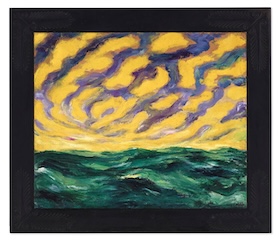
Image: “Herbstmeer XVI,” Emil Nolde, 1911.